Fresh from the killing fields of "research," our heroine appears! Resplendent in some bodacious polished cotton fabric that was probably rejected from the set of "Golden Girls", she demonstrates her abundant charms to the masses.
Bask in the glories of imperious glances and awkward selfies!
Come, my children, into the liiiiiiiiiight....
Dazzle your senses with an alluring up-cup shot of wrinkled fabric and load-bearing 1980's Waverly calico!
Why, hello.
Relish the bewildering confusion of yet another shot of No Bosoms, featuring an enticing peak at the hoarder-style pile of mess accumulating in the corner!
Most of that is my Goodwill pile, I swear.
There are a few important points I'd like to make:
1., These pictures are a bit on the "gently aged" side. Honestly, I think they are over a year old. That's significant because...
2., I'm a whole lot better at drawing my eyebrows on now! And...
3., I've since added bust gussets to liven things up in the Balcony seating, if you catch my drift.
I have no need for 1820-1840 stays, but I wish I were the kind of person who needed them, so I'm making them. It's the Kevin Costner in "Field of Dreams" approach to sewing. "If you elaborately plan, and then poorly execute it, logic will give way to miracles and invitations will coommmme..." Since there isn't precisely a pressing need for this type of garment, I decided to go for broke and make them as versatile as possible. Ideally, they will at least cover me from late Regency- late Romantic.
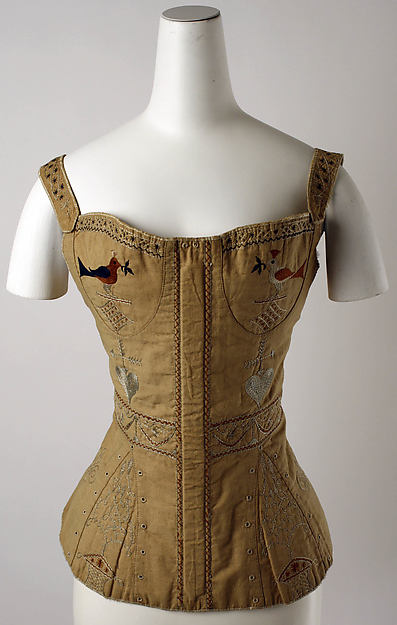
This was the intended target:
Via the Met, home of the Super-Famous Lusciously Embroidered Stays
The mock-up stays that I'm wearing are overall pretty solid in the fit department. The wrinkles at the waist are 99% the result of the incredibly graceful angle from which the picture was taken, and the length and bust height are both good. My original intention was to follow the "pattern" of the inspiration stays as much as possible. But... (there are always buts, even when you think you're just dealing with busts) the original cup design just wasn't working for me. Frankly, it was kind of amazing. I have the same voluptuous curves of a yard stick. What were the chances that I'd stumble upon a bust-cup design that wouldn't leave me enough room??
But, there it is. I agonized over it for a while, and finally decided to deviate. After all, my natural waist is *ha ha haaa ha sob* nowhere NEAR the position of the band on the inspiration stays. Then, I found this lovely pair...
...and I'm pretty sure that they are better suited to MY lovely pair. (har har) Though my need of a bust-gusset does not extend to the range of twosies, this pair of stays was clearly made for someone with my gawky, high-waisted mutant proportions. The plan is now to marry elements of the two stay models, which will probably result in something like this:
The duck-billed platypus of the Historical Costuming community, if you will.
**I have no idea what heinousness has been perpetrated on Blogger over my absence, but suddenly, it's practically impossible to get pictures centered (see most of above), and I have no control over that huge gap at the top. Weird.
After a prolonged bout of whining, I finally managed to compel my long-suffering Manly Person to take a few pictures of the Regency dress that I made for the Historical Sew Fortnightly Challenge # 6. Due to a book signing at work, the annual Mullet and Bullet festival at my favorite local historical site, and this photo-shoot, I've spent three of the past four days in historic dress.
Him: "What exactly are we going for?"
Me: "Pretend like this turns you on."
My inner nerd rejoices. Oh, how she rejoices.
But!!! In addition to pandering to my (undoubtedly) salivating public with soft-focus pictures of myself in Regency drag, I wanted to show off a new piece in my reenactrix arsenal: My frilled collar!
I've blogged about the dress and bonnet before, but haven't had a chance to mention the frill. Here's the scoop: As evidenced by my occasional posts lauding American Duchess (and others), I'm keen on supporting talented, entrepreneurial folks in the historic costuming blogosphere. I purchased this frilled collar from Cassidy at A Most Beguiling Accomplishment a few months ago, and I am so glad that I did! Relentless optimism has its place (in online dating and while eating at restaurants with "B" sanitation grades, for instance), and I'm usually all for trying something that's beyond my skill grade before relenting and sourcing it elsewhere. But, I could not have produced a piece like this. It's exquisitely made, and fits under my modest collection of Regency-wear perfectly.
Cassidy's Etsy shop is called "La Petite Oye". She sells manchettes, collars, and chemisettes (among other things), all of which are made by hand and based on items she has researched. Allow me to repeat that: This is entirely hand-sewn. None of that "visible seams are hand-finished" business. That's classy.
Now, if only I could find an equally unimpeachable source for Regency hairstyling tips for use in 9000% humidity. Seriously... not even a pint of Aqua Net with a dry shampoo shooter can keep a curl crispy in this mess. Just one of the many perks of a day well spent in the hillbilly-scented sauna of South Carolina.
A long time ago, when the earth was still cooling, and I was still participating in the Historical Sew Fortnightly Challenge, I made this here bonnet:
Lots of hand-modeling in this episode. Enjoy.
Well, sort of. The grim reality is that I purchased the bonnet from the nice people at Austentation, admired its braided nude straw goodness for about a month, and then slapped some seasonally indifferent flowers upon it.
And here's how!!
All great projects start with a plan. In my case, I planned to go to bed early one night and instead ended up drunk on Etsy searching for things like "STRAW BONNET REGENCY BONNET REENACTOR FORM STRAW." That led me to Austentation's Etsy shop (the link is to their website), and eventually to the fine piece of millinery you see above. Once I had the bonnet in hand, I sought out inspiration. As you can imagine, there is NO lack of 200-year old bad bonnet ideas.
Courtesy of Nuranar, who haunts my dreams AND my blog. I promise... the purple ruffle monster is not forgotten!
The relative simplicity of the plaid-trimmed number appealed to me, (sandwiched as it is between what appear to be lampshades embellished with adult diapers). But where does a girl find scalloped plaid silk ribbon in this crazy, crazy world?? Oh, yeah...
Using only a hammer, pinking iron and the power of my opposable thumbs, I violently carefully beautified the edges of some scrap silk taffeta that I'd previously cut into strips.
And then played around with them, singly and in layers, until I liked the effect. Everything was tacked onto the bonnet with brown cotton thread and my largest blunt needle. (It takes a while, but I can learn!)
I acquired the poppies for this bonnet from H*bby L*bby, but the rest of the bodacious floral bounty is left over from other projects. The flowers were sewn down by their stems, one at a time. Each stem is wrapped around at least one other flower before being attached. I tell myself that this is to ensure stability and strength, but in all honesty, it just made the sewing easier. (No more roly-poly stem chasing!)
Yes, the poppies look sad. You'd look sad too if you had to ride around on my head.
Sooo.... who wants to help me create a South Carolina chapter of the Regency Society?? Seriously, I have NOWHERE TO WEAR THIS STUFF. It's pathetic. No War of 1812 Battle Reenactments, no Regency Fairs (or Faires or Fayres), no nuttin'. Perhaps it's finally time to post an advertisement in the local paper and reach out to my fellow costuming nutcases.
Or maybe I'll just stick with my current occupation of eating drugstore chocolate and writing to strangers on the internet.
Yeah... that sounds like a solid plan.
The Challenge: #7: Accessorize!
Fabric: Scraps of pink plaid silk taffeta left over from... you guessed it! The Jehossee Project.
Pattern: NEVER!!!!
Year: 1812ish
Notions: Assorted faux-floral odds and bits, thread, and silk remnant masquerading as ribbons.
How historically accurate is it? Aside from the questionable flower content, not bad.
Not to pretend that my posts are ever the result of laser-like focus, I'd still like to warn you in advance that this particular post is especially random and off-topic.
As most of you have tried very hard to forget, I work at a bookstore in a very small town. My days are spent in awkward extremes: I answer emails and handle customer service for our thriving online business selling new books, as well as working with "vintage" (used!) and "antique" (very used!) books that are traded and donated to the store. I won't lie... it's an incredibly glamorous life. One minute, I'm trying to explain to an elderly lady in HorseShoe Bend, Idaho that her recently purchased e-Book will not be coming in the mail anytime soon. Then a little later, I'm rummaging through a rat-chewed box of dilapidated estate-sale books donated by a grunting family of non-reading locals who insist that "ain't nobody gonna read that stuff 'cause it's boring."
And, to be fair, a lot of it is boring. But! Sometimes, there are lovely, dusty old books with the scent of sweetly aging paper. And sometimes, those wonderful old books settle into your open palm like a broody bird on a nest, and fall open with something akin to a sigh. And sometimes (more often than you'd think), something secret and sacred, committed in elegant spirals of ink upon crisp paper will flutter to the floor. I love the things people tuck inside of books. It's a such a human habit! We can't help ourselves. I've found money, love notes, wedding photos, divorce decrees, car titles, ultra-sound pictures, movie tickets, playing cards, post cards, speeding tickets, hair bows, canned food labels, handkerchiefs, swizzle sticks, canceled stamps and more. My favorites, though, are old letters.
For those of you who are still with me, what follows is a transcription of a letter I found this week inside of an 1880's children's book. It features hot n' heavy talk of family flannel-drawer making (including a pair for "Budgie" the dog?). I hope you enjoy it! (And for the quitters who can't face another wall of text, see you next time!)
Home 10-12-1891 Dear Daughter- I am commencing thy letter with Budgie in my lap. He got hurt and feels as though he is a baby. Pa had just come home from [the] mill and he got in the hack and was on top of the sacks and slipped some way and almost fell out but hit on the wheel and cut a gash about an inch long just over the outer part of his right eye. It has bled a good deal and yet almost 2 hours since it happened is bleeding some yet. And now he has got ink all over my paper. So thee can play that is a kiss from him to thee. Anna brought her books home this evening and isn't going to Brushwood any more. But will start to No. 1 I suppose and Emma wanted to stop to[o] and the other girls wanted to know if they might stop of Brushwood if Emma did. I told them they could but Emma would not stop. And so that nipped it all in the bud. The Academy is having a boom this fall. I believe they have seventy pupils now. The largest number they ever had during one term. I guess I will have enough cider left to make all the pickles thee can eat for one while. I have made 1 1/2 gallons of mixed pickles and nearly 3 of Margo's and am going to make pickle lilly yet. I got a letter from Uncle Ed the other day. He says he is very poorly and Lind has been out lately and Bruce is going to Lind's and study Telegraphy and Iona is going to school at Deming, and there was a picture of Mark in his wagon and his goats hitched to it. It looks very much like him. And Uncle Ed said that he would watch out for thee a place. He is Principal of a ward school and has seven teachers under him. Their baby's name is Georgie. We have pumpkins like every thing. Sallie brought up three wagon loads this afternoon and there had been about 2 loads brought up before. How are thy canton flannel drawers? I never thought to ask about them when thee was at home. We are in the business this week. We have made Pa two pairs today also Emma the same number. We wanted to make for Mary, Grace, Jessie and myself yet and make some for Budgie. If thee has money enough I guess thee had better get thee a gossamer. I intended to have got thee one during the summer, but thee knows when we went to town what a time we would have spending money. I wish thee would come home every morning and comb my hair. Then I would give thee thy breakfast in exchange. Well I have about run out of anything to say and will close for this time. We will bring Mary home sixth day. We have about a bushel of walnuts and peck of hickory nuts. Don't know whether we will get any more or not. Bye Bye- Mamma
Welcome to the sixth installment of the Historical Sew Fortnightly Challenge: Stripes! I've made a Regency dress! If only I had a Homeschool Prom to attend whilst wearing it, my life could at last be complete.
Instead, I'll be filling the void by sitting at home in my pretty stripedy frock as I drink wine from a box, write embittered late-night WTF: Regency posts and talk to my cat. It's what Jane Austen would have wanted, I'm sure of it.
It is a testimony to my lack of proper feminine instinct that I have failed to produce a Regency-style dress til now. Isn't there a clause somewhere in the government-issued booklet that girls receive at birth stating that you must read Emma by the age of 17 and then immediately afterward attempt to cobble together an empire-waist dress? Consider this gown to be yet another milestone in my own awkward, prolonged puberty. (Dammit, I'm not going to act like a grown-up until the acne goes away!)
This dress was constructed like everything else I make: with almost no foresight or planning, and very little skill. I draped the bodice onto Headless June using some bodacious crappity-scrappity fabric that I possess (sorry... no pictures of that), and adjusted the proportions and seam positions until it felt right. For the most part, I relied on this dress for inspiration, though I omitted the back ties and drawstring, and my sleeves are shorter. (I stared at this one as well, but there aren't many pictures of the details.)
Rebel that I am, I mixed up my stitchery a bit. The areas that are likely to experience the most stress (armpits, center back, etc.), I finished with a back-stitch. Everything else is in a spaced back-stitch. You can see the transition in the armscye above.
The bodice is lined in cream cotton sateen, except for the bib. I used a scrap of the calico lining from my gold round-gown for that. The sleeves are mostly lined with muslin, but I used scraps of the striped fashion fabric for the first 4" or so of the bottom of the sleeve. The insides of the sleeves are not at all visible when the dress is on, but it seemed a reasonable precaution.
Since the inspiration gown has the nifty little inner bodice flaps, I did the same thing. I wanted mine to pin closed rather than tie, though. (I didn't want a drawstring in the bodice and the ties would have added lumpy weirdness under the flat, re-designed bib. LUMPY WEIRDNESS, I SAY!) They are made of white cotton sateen and attached over the finished interior edge. I have no idea if what I did there is correct, but I sure as heck did it. They support my meager bust in addition to closing the sides of the dress. Brilliant!
The skirt is unlined. Honestly, if I were to make this dress again, I would line the skirt. The quilting cotton I used is just a little too thin to hang properly on its own. Hopefully, a period appropriate petticoat or two will help. The material of the skirt is pleated to a band and then enclosed between the bodice fashion fabric and lining. Per the original gown, the bulk of the skirt is pleated at the center back. (I'm making a little pillow that will be sewn under the pleats to support the back. They're hanging a little flat at the moment.)
Why, hello there matching back stripes.
Regency gowns are generally constructed to play up the "small back" of the wearer. I pandered to this oft-quoted historical costuming trope by using the stripes to form a chevron pattern and inset the sleeves as far back as I could without over-reaching the limits of my own range of motion. There's a knack to setting these sleeves... a wide armscye will give you a much broader range of motion, but your sleeve has to have just enough bulk to allow your arm to take advantage of it. Otherwise, the tiny back/deep armscye combination restricts your arm movement considerably. Needless to say, I am still learning the ins and outs of this balancing act.
I purchased the fabric for this dress over three years ago during an epic Hanc*ck Fabrics sale at my local store. This was a remnant on a bolt with a generous 50" selvedge. That is a critical factor for the following reason: this dress is made with barely 3 yards of fabric. That may not impress some of you delicate, precious creatures out there with your tiny feet and non-monstrous legs and arms. But my Sasquatch-esque extremities usually command more prodigious yardages.
I want pictures! Soon! It unexpectedly rained today, so my resident photographer went out to get groceries. The dress is considerably shorter on me than it is on Headless June, so it will look a bit different. I don't have proper undergarments yet for this era, though I do have a pair of busked c. 1820-1840 mock-up stays I've made for the Flora and Fauna challenge. They were used for most of the fitting.
And that concludes this episode of Thread-Head Theatre. Except for the paperwork! Read on!
Attack of the Facts:
The Challenge: #6: Stripes!
Fabric: 3-ish yards of reproduction quilter's cotton. (Labeled "1830-1860," but I think it looks a lot like an early roller-print. Maybe that's wishful thinking.)
Pattern: Draped directly onto Headless June as a mock-up in Grandma's Sofa Floral Cotton and adjusted in situ.
Year: 1810's. I've personally examined a very similar bib-front gown from the 1790's made of striped linen, and the primary inspiration dress is described as "1800-1810."
Notions: White cotton thread and 5 steel pins. (Pins are for closure.)
How historically accurate is it? I gave it an 8.5/10 on the HSF Facebook page. The fabric is not a great weight and the construction method is questionable. I made a lot of it up as I went along, consulting pictures for help. However, it's entirely hand-sewn and finished on the inside about a neatly as most of the originals I've seen.
Hours to complete: About 10. Most of the major time was spent on fitting the bodice.
First worn: Yesterday (March 23) to check the fit. I haven't worn it at all since I finished the hem, but I hope to remedy that soon! It rained all day today, ruining my planned photo op.
Total cost: The fabric cost... $1.00 per yard. Yes. Even including the exponential cost of thread and pins, I'm in under $4.00.
I've gone and sewed some flotsam to a bonnet, an activity which required neither skill nor cunning. (And surprisingly little pre-meditation!) There's no need to beat a dead bonnet, so I shall endeavor to keep my punch-drunk, sleep deprived self on the modest side of the usual descriptive quagmire I write myself into!
Oooh. Did you read that last sentence? We're off to a terrible start. Best get this over with.
Some of you may remember the smug bit of rubbish I wrote last year about turning 30 and buying a bonnet.(And for those of you who don't remember, congratulate yourself on your excellent judgement! Or follow the link.) For the Fourth Historical Sew Fortnightly Challenge (embellish!) I decided that it was high time I decorated my lovely Timely Tresses acquisition.
Image courtesy of the National Trust Collections, who will NOT be made to photograph anything from the front, because that's just the sort of thing that got HRH Kate in trouble.
My inspiration was this c. 1840-1850 bonnet from the National Trust Collections. This particular bonnet was selected because the shape of my bonnet is nearly identical, and the time ascribed to the inspiration piece played wondrously into my devious little hands. You see, I wanted a bonnet I could wear at Civil War events without raising too much of a fuss, but something that could also conceivably be displayed with the Jehossee Exhibit if need be. A Time Lord of bonnets, if you will.
The middle of the nineteenth century is not a great time to decide you want a chapeau that will accommodate a 15 year time span. But a Thread-Head's gotta do what a Thread-Head's gotta do.
I started the embellishment process by rounding up a piece of scrap silk that was too small to do anything else with. (It is actually too small for this project as well, but who needs to actually TIE their bonnet strings?? NAME ONE PERSON. That's what I thought.) I cut the silk into roughly 4" strips with the pinking shears I never use, and began pleating the fabric inside the brim.
The pleats are not precise. Frankly, if the surviving examples are any indication, bonnet trimming was a brutal, haphazard sport in the Antebellum era. (Some of them look as if the ribbon was applied with a cannon.) The silk I used is not remotely starchy or crisp, so I was forced to accept a certain... draped quality to the pleats.
I used pretty much every needle I own at some point in this process. It was ridiculous. I started with my weapon of choice, a #12. That was tough going, so I ended up with the beloved vintage darning needle. That was a bust too, which ultimately led me down the rabbit-hole to a needle that I have no other earthly use for: a book-binding needle. Blunt, solid, short and possessing an eye commodious enough to house a family of four, it was the last thing that I thought would work. (Hence, why I tried it last.) But it was great! The blunt tip spread the fibers of the straw rather than stabbing through them, and the large eye protected the thread from the ravages of the straw. Who knew?
My bavolet is precariously created from the very last scraps of 4" silk that I'd cut. The chain-stitch across the bottom is H.U.G.E.... but so is the design on the original. Historical relevance for the win!
Regrettably, my photo documentary ends here abruptly. After attaching the bavolet, I ran another row of stitches across the front frill of silk, roughly 1.25" from the pinked edge. It was the only solution I saw to a dreadful case of Flaccid Silk-itis. (When the bonnet was on, I looked like I had upholstered Zooey Deschanel bangs.) Then, in the manner of the Romans, I threw crap all over the bonnet until it could take no more. When at last it was full, I threw even more crap at it. Then I sewed the crap to the other crap.
I've never felt more alive.
I then dragged it to the Archives and stuck it in a display case as part of the Jehossee diplay. Since it's living in 1850 at the moment, I tried to play up the horizontal look of things rather than the vertical. That said, I failed to get a single decent picture of the bonnet on a human head post-production. The stuffed head above does a lovely job of supporting it, but cannot provide the proper foundation of 1850's hair.
These pictures were taken after the bonnet was put on display and they were all taken from the outside of the case. Brilliant, yes, I know. *Sigh.* Why must I be merely beautiful instead of organized?
In addition to the saffron silk, I used cotton embroidery floss, felt pussy willows, wax blueberries, and some lovely blue plaid ribbon. The plaid ribbon was culled from the $1.00 bin at Micheal's (our local branch of a semi-national craft chain). It is not a natural fiber ribbon, but desperation won the day. Plus, I really love the ribbon.
And Huzzah! Blammo! Bonnet!
Hats Facts:
The Challenge: #4: Embellish!
Fabric: A 15" by 30" piece of saffron colored silk.
Pattern: Are there patterns for things like this?! None used. Images of extant bonnets were consulted. Year: 1850-1865. (But really, I'll take any combination of those years. Right now we're going for 1850-1855.)
Notions: Yes! This was the Big Show for notions. I used:
3 kinds of thread! (cotton embroidery floss plus yellow and brown cotton quilting thread.)
Ribbon!
Wax blueberries!
Felt pussy willows!
Pinking shears! (They deserved a second mention.)
How historically accurate is it? With the exception of the VERY inaccurate blue plaid ribbon, everything else used is at least plausible. When I find appropriate replacement ribbon for the blue plaid, it can be changed out. I'm giving this one a 9 of 10.
Hours to complete: 6ish.
First worn: I had it on several times after it was finished, just for fun. It has not been worn with historical intent at all, though it is currently on display with Antebellum clothing. Did we ever decide if that counted?
Total cost: The bonnet was an initial investment of $85, I think. I purchased the blueberries and pussy willows on sale over the course of the past year. I wouldn't have paid more than $3.00 per pick, so the lot comes to $6.00. Blue plaid ribbon was $1.00. Everything else was stash stuff. Roughly $100, if you count the shipping on the bonnet when I bought it.
Some say that only the French can truly understand l'art de la Romance. I disagree. In honor of Valentine's Day, I present a very English fashion plate as my... "special" valentine to all of you.
Rendered in the rapturous glowing pastels of a Summer sunset over the Thames is this gorgeous image from our friends at La Belle Asfemblee. And who but they could have captured the resplendent elegance of this lovely damsel in her new pink frock? Truly, an artist of the highest caliber was employed for this plate; an individual singularly in tune with both the wisdom of the Old Masters and the inspirational qualities of an opium pipe.
Appreciate, if you can, the emphasis on our Rosie's waist. A bedazzled belt? Absolutely! But open your mind... allow your inner eye to embrace the glory of her embellished skirt! Savor the immutable charm of a series of graduated trapezoids that vaguely resemble scabby dresser drawers. And what could be more romantic than thinking of a woman's scabby drawers?
Consider, if you are able, the divine mystery of a one-legged maiden; Where did her other foot go? Why is she wearing the wrong shoe on her one remaining foot? How has she come to have a slab of bacon upon her coiffure?
Discern, if you are so gifted, the veritable Gordian Knot of bosom she boasts! Observe the seemingly haphazard arrangement of flesh... is it so random after all? Of course not! A true artist sees immediately that she represents the divine Justitia, and her roving spencer weasels are the very scales of Justice. These are poignant remembrances of the imbalance we often face in matters of equity and fairness, as well as a startling reminder to never insert a wooden busk in your stays while intoxicated.
Happy Valentine's Day, folks!
With all the love in the world to Nuranar, who probably weeps every time she opens her Flickr album.
It is a little-known point of 1807 etiquette that, when exposed to the naughty bits of another woman on the streets of London, propriety demanded that you immediately renounce all natural pigmentation as well as your left arm:
"Wihemina, PLEASE. Just tell me if it looks malignant. That's all I'm asking."
Her look of righteous indignation only adds to the unmistakable allure of our pallid amputee, along with the intriguing addition of a spangled bell-pull at the décolletage. (Ring for service!) Not to be outdone, the glories of Lady Violet's feminine apparatus have been further embellished by a coat trimmed in an exuberant halo of spotted Polish rat-pelt and the aggressive use of turban tassels.
One does wonder at her decision to divert focus, but perhaps they match the tassels in the front.
UPDATE 1/29/13:
This post was originally published without a source or credit. Luckily, one of the much more proficient historical fashion enthusiasts among us let me know that this is from the University of Washington. I contacted them regarding the use of this image and I'm happy to say that THEY HATH SPOKEN! (And quickly, at that.) With the proper tagline and a manic gleam of self-congratulatory compliance in my eye, I am at liberty to cull their vast and awesome collections for many, many more abuses of the WTF Fashion Plate variety in the future.
Now, you may all return to your erotic fantasies of the cast of Downton Abbey.
This fashion plate brazenly challenges prevailing scientific dogma on both the potential growth rate of muslin-feeding paramecium and the origins of the home self-breast exam.
Our lady demonstrates that she's cultured in more ways than one by successfully marrying the tenacious allure of a bicep vine with the subtle mystique of a partially obscured potty chair.
And that, my friends, is why you should party like it's 1809 this New Year's Eve.
A solemn bow to Nuranar, who is probably in witness protection by now.
So... yeah. This is a pirate post. Yarrgghh. I'm pretty sure that about 99% of the images in this post are un-credited or improperly credited or blatantly stolen. They all came from the murky depths of a crippled zip-drive and in the American spirit of "But I don't WANT to!", I refuse to track them all down again and do this correctly.
Journal of the American Institute for Conservation. This I just swiped tonight. I love this kind of stuff. This is somebody's whored up 15-year old daughter wearing MARY TODD LINCOLN'S OPERA CAPE. The one that has ABRAHAM LINCOLN'S BLOOD ON IT. But you know, photo ops gotta happen.
But then, if you are seeking class, refinement and a sense of moral and personal responsibility, you probably aren't reading this anyway. And if you are determined to enjoy the illicit fruits of my highly suspect "scholarly" rambling but need a little Protestant absolution for your sins, go kick around on Pinterest for a while. (Pinterest... where almost anything can have a fan club, and un-credited photos get swapped around like crotch rot in an army camp.)
Mary's wrist watch. Get this... she's one of the first people known to actually use a wrist watch. Granted, this is clearly a "cross-over" piece of jewelry that just happens to include a time-piece (that front bit is hinged) but still! This came from an auction, I think?
I'm a Mary Lincoln nerd from way back. (Okay... maybe just four years back. Whatever. Sue me.) Deep in the "not quite fit for company" archives of Thread-Headed unpublished bilge are a couple of blog posts about Mary's apocryphal childhood hoop-skirt and another about her relationship with her White House seamstress and friend, Elizabeth Keckley. But I've read so many neat things about the making of the new "Lincoln" movie lately, and they got me to thinkin' about Mmmmary, so here we are.
Mary's checked wrapper and cape. This little number has a cute coat-sleeved dress under the capey goodness, but I cannot find the one picture I used to have of the full dress. Courtesy of the Chicago History Museum, but they don't show the whole thing on that link and you can't capture the image from the museum site. So I have no idea how I have this. You're welcome.
Several years ago, I had the opportunity to do a focused project on Mary Todd Lincoln for an American history class. It was meant to be a selective overview of the clothing of Abraham Lincoln, his wife and their children. So naturally I cheerfully and unrepentantly did nothing of the kind, and instead turned in 80+ pages of pictures and assorted prose on the wild n' wacky wardrobe of Abe's main squeeze. As it happens, there are a frickin' ton of artifacts associated with Mary Lincoln that have survived, ranging from earrings and watch fobs to full dresses and even her toilet. This is due in large part to her relentless buying-and-purging habits, but it's a boon to Lincoln enthusiasts.
Kent State Museum. Elizabeth Keckley made this quilt *supposedly* out of scraps of material left over from the many garments she made for Mary Lincoln. The quilt may have been made during the White House years, but possible started much later.
And hoarding enthusiasts. Mary spent the last few years of her life, rockin' it out like a hoarding rock star. She kept a room full of trunks which were in turn full of fabric and clothing that she couldn't use or wear. The room was so over-crowded and packed that a family maid refused to sleep in her appointed room because the constant screech and sag of the floor-boards in Mary's room above (which formed her ceiling) kept her awake at night. The best part? It wasn't her room OR her house she was slowly destroying... She was a guest. A hoarding, belligerent, demented guest. Demented? Yes, demented. Mary's elevator quit servicing the top floors back before Abe died. By the time she lost her youngest son nearly 10 years after Abraham was murdered, even the fire escapes were closed.
First known photograph of Mary Lincoln. Taken in or around 1847, way before she buried three of her four children and lost her husband. Love the stripes and the magnificent over-accessorizing. A pin! And a sheer lace shawl! And a belt! With a buckle! Some super-lacey contrasting sleeve inserts! And some non-functioning buttons down the skirt! Perfection.
But clothes! Pretty clothes!
Postcard from the Smithsonian, showing what is probably the most iconic "Mary" dress in existence today as it was styled by the museum staff in the 1950s or 60s. You can almost hear the conservators saying: "Yeah, so maybe it didn't puddle on the floor when she wore it, but hoop-skirts are like, totally tacky. But I really like the neckline all jacked up on her shoulders like that... that was a good idea, Janice."
"Thanks, Mark. It just felt right. Let's go try on Washington's Pantaloons again."
Scattered through this post are some of the things most commonly (or maybe not so commonly) associated with Mary Todd Lincoln. Despite the warning at top, I've tried to link back where possible, but please forgive any oversights. (Or help! If you recognize something, lemme know!) One of the most interesting aspects of researching Mary Lincoln's wardrobe is the preponderance of contradictory information you encounter. Some claim that only one original dress survives. Some claim four. Others, seven. The video at the bottom features a very well-spoken young man who confidently states that only two complete gowns survive. (The Strawberry dress and the assassination-night dress.) The fact that the Smithsonian has both the purple velvet gown seen above (including the day bodice that matches the skirt) as well as an altered silk striped gown that has been partially restored automatically calls his statement into question. In the course of my research, I've encountered the following (mostly) complete garments that are associated with Mary Lincoln. As far as I know, these have excellent provenance:
* The Keckley-made purple velvet evening and day ensemble at the Smithsonian.
* The striped silk (patterned with violets and black stripes) also at the Smithsonian.
* The Strawberry dress at the Abraham Lincoln Presidential Library.
* The green and white "buffalo check" dress and cape from the Chicago Historical Museum. (Third image down)
Then there are a few "maybes" out there:
* Homeskillet in the video below claims that the assassination dress is still around... that is possible but there are numerous accounts of it being cut into pieces by Mary for relic-hunters and mementos for family.
* The Ford Museum has a truly amazing orange and cream silk number (with shoes!) that they claim belonged to Mary. My issue is that it looks very late 1860's, and Mary wore black from Abraham's death until her own death in 1882. (Except on Tad's 16th birthday, because he asked nicely.)
* Supposedly the Mary Todd Lincoln House has an original garment that was donated. They frequently display re-creations of Antebellum clothing, but I have never seen any images of the purported original.
* The Lincoln Library received a donation of a skirt that was supposed to be from Mary's wedding dress several years ago. The garment came along with a donation of Lincoln's briefcase. (wow.) To my knowledge, it has not been displayed (but I'm not sure of that.)
That doesn't include the fragmentary garments and large accessories such as the cape at top, at least two possible "mourning skirts" and a bevy of fans, handkerchiefs, shawls, bonnets and even several chemises.
I suppose it's only appropriate that Mary's residual wardrobe is something of a scattered mystery, since that's ultimately what history has made of the woman herself.
As a special bonus treat for hanging in there til the bloody end, here's that video I promised of a posh museum-type talking about the "Strawberry Dress" in the collection of the Lincoln Library.
Video scalped from YouTube, courtesy of the Lincoln Library. Starring the awesomely elusive Strawberry Dress!
That goes for everyone who has been in the armed forces or who has loved someone who served. A Thread-Headed salute to you all, and a smile of gratitude too. So naturally, this particular voyage into the vulgar and trite is in honor of Veteran's Day. (hey... I do what I can.)
Occasionally, while trolling the vast network of images and information that my mother calls "the ninnernet," I come across Regency-era fashion plates that have absolutely nothing wrong with them.
No, really! It's true!
Luckily, these are not those.
First up: The Hand Jive.
I am seriously in love with that pretty red vine border she's slammin' down on that kerchief. I have some concerns about her choice of a fork handle in place of a sewing needle, but what do I know? I've never been schooled in the feminine arts.
Except for lying, of course. And eating chocolate instead of paying my taxes every year... wait. Where was I?
Next up: Pink Fink.
Ahh... VELOUR. No word conveys the expectation of class and elegance quite like "Velour." Our Mauve Mavin seems to have found a clever way of avoiding the needle-related difficulties of her compatriot up there above: simply embroider without a needle. Or thread. Or scissors. Well, really. Who are we to judge? Maybe on alternate weekdays she just likes to find a few moments alone to sit on her special octo-stool and cuddle her embroidery. Maybe she's the embroidery whisperer.
Maybe she's embroidering... with her mind.
Somebody please explain the physics of this dress. How is this position possible in this skirt? She's attained the elusive 9-point wedgie and STILL that hem is hanging evenly!
Moving on: Knits Knot What You Think.
Okay. So I'm not one of those girls who has ever, EVER, had difficulty seeing her feet. I wear a bra much in the same way kids hang out Christmas stockings each year: with hope that one day soon, they'll wake up and find the thing full.
But I digress.
Our knitter extraordinaire here clearly does not share my plight. You'd think that a woman with such... "great tracts of land" would have figured out a way to hone her craft ABOVE the equator by now. Because really, there is no chance that she can see anything that's in her hands at the moment, even with 4-foot long knitting needles. Nor can she go by feel. Why? Because she's knitting while wearing opera-length leather gloves.
As we do.
Based on the size of needles and the World's Biggest Ball of Twine chillin' out on the floor over there, I'm guessing she's making a scarf.
For Napoleon's ego.
Which brings us to: Rove, Rove, Rove your Boat.
Perhaps the most fascinating aspect of the image below is the description. Or rather, the lack of description. We think we are gazing upon a fair maiden spinning the Pope's salt water taffy into fishing lures, while wearing a tragic front-opening vest apparatus and the most unnecessary collection of ruffles EVER (bicep garters??), all of which is surmounted by a kerchief that she clearly stole from color-blind Gypsies.
And what does Costume Parisien have to say about all of this? For answers, we turn to the source:
"Cap of Organdy."
Cool. Thanks for clearing that up, Costume Parisien!! Back to spinning, now. His Holiness's delicious snook bait ain't gonna twist itself.
Furry Finis.
Here we have the curious image of a woman who is expressing the timeless, universal hand sign for "What the hell is this thing?"
Maybe it's vaguely related to sewing! So I'll include it in this post! And even if it isn't, perhaps she can somehow use it to MacGyver a solution to her "prehensile amputated monkey tail boa" problem.
I'd like to think that there are a bunch of little Regency-lings huddled on the floor behind her, listening with rapt awe as she rambles about "the old days"... you know, before the Directoire. Sure, a lot of people lost their heads. But not her! No sir. That "Demi Turban Palatine" is holding on for dear life.
I assume "Demi Turban Palatine" translates loosely to "Bundt Pan With A Fear Of Heights."
In other news, Liz at The Pragmatic Costumer is celebrating a blogging milestone: 100,000 views! That's awesome for several reasons, namely because she has only been blogging at that particular venue for about a year. A YEAR. It's also awesome because she's great at what she does. If you haven't discovered her yet, treat yourself: start with the "Pragmatic Manifesto" and go from there.
Happy reading!
Today's pile of plates brought to you by Nuranar. Viva la Nuranar!
"Mavis Whittle-Snape had occasion to reflect upon her folly many times that day, none so much as when she met Beatrice McBlodgins in the avenue on the way to watch a public execution."
Mavis: "Good-day, Beatrice. Won't you join me at the gallows?" Beatrice: "Thank you, no, Mavis. But let's not mince words. I can see your... rather sheer shift." Mavis: "That's not a shift. That's a petticoat." Beatrice: "Fine. But I can see the junction."
Bloody brilliant. This solves so many dilemmas of etiquette ... that timeless question of what to wear when you want to prostitute yourself, but you also need to attend an infant baptism later in the day? A completely sheer gown and chapeau combo with a modesty apron, of course! The only thing that's actually lined on the entire ensemble is the lower sleeves. An odd touch, that. I suppose she wished to avoid the scandal that visible forearms would have ignited.
And possibly the most unbelievable aspect of this whole thing: who would wear this in May in LONDON? It's about 58 degrees at high-noon in London, in May. I would say "in the sun" rather than "noon," but as we all know, January to December is the rainy season in England.
All my best to Nuranar, who is probably wishing that I was a little less assiduous in giving credit for images right now.
This dress marries the divine elegance of over-sized staples with the timeless, understated glamour of a sunflower glued to the knee. Added to this piquant ambrosia is our obviously near-sighted heroine, who isn't sure whether she's holding her fan or a croissant, but she hopes to muster up the correct answer before anyone sees her nibbling the decorative paper.
Reasonably convincing Goddess Diana replica tiara: 38 shillings.
Leaving the entire top of your gown unlaced: Priceless.
Much love and mad props to Nuranar, who deserves better than this.
With all due respect to the ancient and noble profession of Fashion Plate Illustrator, seriously, what are you people smoking? Does it REALLY show off the sexy new dress better if a buxom beauty is clawing at her rump with an apparently broken arm? Should we be reading scenes like this between the lines of every Jane Austen novel? Maybe Bingley would've made his move on Jane Bennet earlier if she hadn't been digging for gold at the dance. Or maybe she wasn't digging hard enough.
Historical context, people. It's all around us.
Thanks again to Nuranar, who probably never intended for things like this to happen.